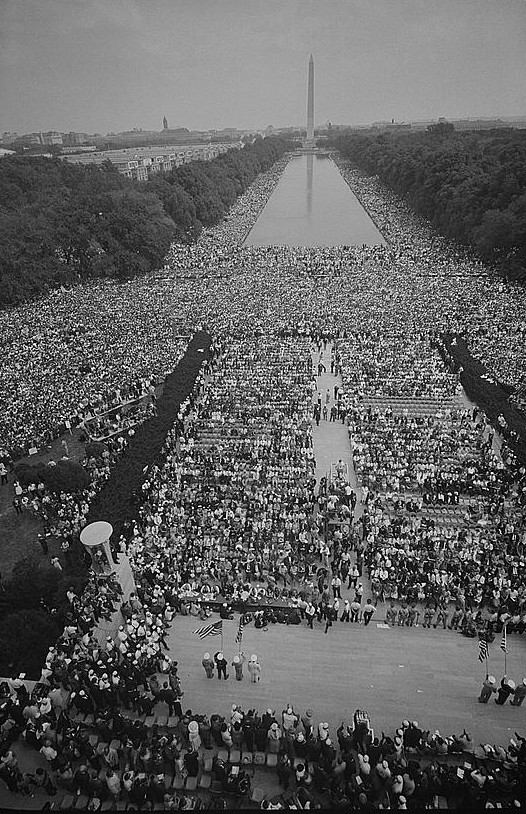
Martin Luther King Jr. gave the “I Have a Dream” speech on August 28, 1963, from the steps of the Lincoln Memorial in Washington, D.C. It closed the March on Washington for Jobs and Freedom, which drew more than 250,000 people.
- Date: Wednesday, August 28, 1963
- Place: Lincoln Memorial, Washington, D.C.
- Event: March on Washington for Jobs and Freedom
- Crowd: more than 250,000
- Speaker order: 16th of 18 items on the program
What happened that day
The March on Washington for Jobs and Freedom brought more than 250,000 demonstrators to the capital, the largest demonstration for human rights in U.S. history up to that point. A. Philip Randolph conceived the march and served as its director, and his longtime associate Bayard Rustin organized it (National Archives).
The day ended with a program at the Lincoln Memorial. King spoke near the very end, after Rabbi Joachim Prinz. Only Randolph’s pledge and a benediction by Dr. Benjamin E. Mays followed him (National Archives).
- 15Rabbi Joachim Prinz
- 16Rev. Dr. Martin Luther King Jr.
- 17The Pledge, A. Philip Randolph
- 18Benediction, Dr. Benjamin E. Mays
The speech in five moves
The speech builds in a clear arc, from the nation’s unkept promise to a vision of freedom reaching every corner of the country. Here is how it moves, in our words.
A promise a century late
King opens in the shadow of Lincoln, a hundred years after the Emancipation Proclamation, and says Black Americans are still not free.
The check that came back
He compares the Constitution and the Declaration of Independence to a promise of payment that America has failed to honor for its citizens of color, and says the marchers have come to collect.
Now, not later
He rejects the idea of waiting and warns that the country cannot go back to business as usual.
Dignity and discipline
He calls for struggle without bitterness or violence, and says Black and white Americans’ futures are bound together.
The dream, and freedom ringing
He lays out his dream of an America where his children are judged by character, names Georgia, Mississippi, and Alabama, and closes by calling for freedom to ring from mountains across the country.
Was the “I have a dream” part improvised?
Partly. King read from a prepared text for much of the speech. When the crowd’s response swelled, he set the manuscript aside and turned to the “I have a dream” refrain, which he had used many times before (King Institute, Stanford).
The ideas were not new either. King had spoken of freedom ringing from the nation’s mountains as early as 1957, and of America as a dream not yet fulfilled from 1960 on. Two months before the march, he gave a version of the dream passage at a rally in Detroit. His adviser Clarence Jones suggested the image of an unpaid promise that frames the opening (King Institute, Stanford).
Why isn’t the full text on this page?
The speech is still under copyright. King asserted it in 1963, his estate has defended it in court, and it stays protected until 2058 (Copyright Lately). The estate’s licensing agent is Intellectual Properties Management (King Institute, Stanford). That is why we quote only a few words and point you to a trusted place to read and hear it.
Read and hear the full speech
Freedom’s Ring, a project of the Martin Luther King, Jr. Research and Education Institute at Stanford, lets you hear the speech and compare what King wrote with what he said.
Open Freedom’s RingStand where he stood
A marker set into the steps of the Lincoln Memorial, on the National Mall, shows where King gave the speech (National Park Service). For more places tied to his life, see Black History Museums and Historic Places to Visit, and read his story with others on Important People in Black American History.
Sources
- Martin Luther King, Jr. Research and Education Institute, Stanford University. "I Have a Dream." Accessed October 19, 2026.
- National Archives. "Official Program for the March on Washington (1963)." Milestone Documents. Accessed October 19, 2026.
- Martin Luther King, Jr. Research and Education Institute, Stanford University. "Freedom’s Ring." Accessed October 19, 2026.
- National Park Service. "Lincoln Memorial “I Have a Dream” Marker." National Mall and Memorial Parks. Accessed October 19, 2026.
- Copyright Lately. "The Copyright Legacy of Martin Luther King." Accessed October 19, 2026.